
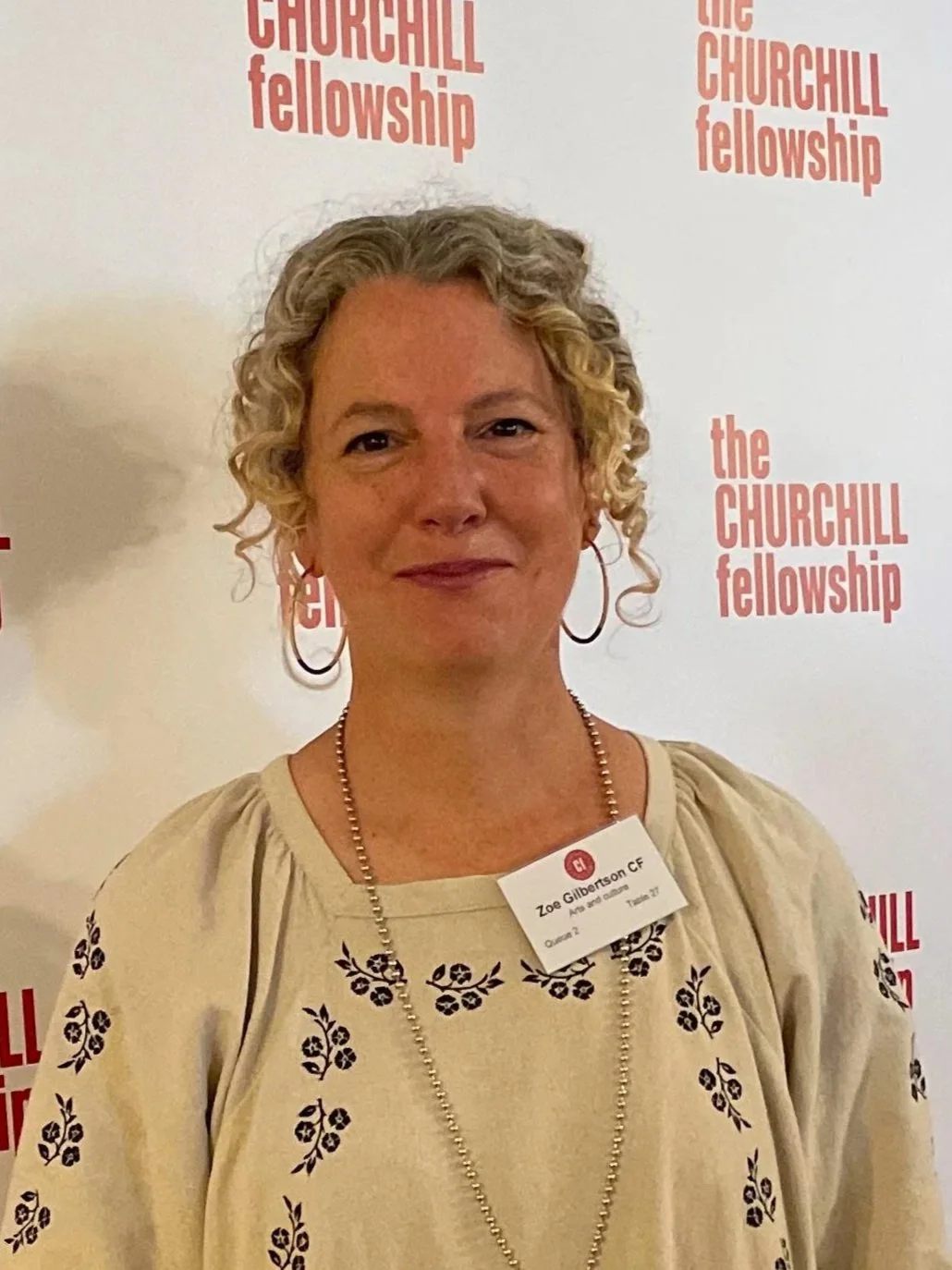
Our thirty-seventh member of the month is Zoe Gilbertson
UCRF is running a ‘Member of the Month’ feature on this blog, where a member, selected at random from the membership database, is sent five questions to give us all an overview of our members. Our thirty-seventh participant, Zoe Gilbertson, is a designer, researcher, and practitioner working on locally rooted material systems, community resilience, and ecological approaches to production, with a focus on reconnecting clothing and textiles with place, landscape, and local knowledge.
—1. How would you sum up your research/practice?
My take is that as humans we must connect to local places, people and landscapes and production of most goods must be developed within this context. We cannot keep extracting from other people and places and the likely future climate issues and global conflicts will prevent it any way. What mainstream/western fashion represents is ecologically and culturally devastating and we must create new systems that allow for a gentler culture to emerge. This culture must support a plurality of clothing systems and expressions.
—2. How do you address fashion and sustainability in your work?
About 3 years ago I left formal research and fashion education to pursue action on the ground. I founded Liflad CIC, a not-for-profit design lab developing strategy and practice to enable meaningful livelihoods rooted in nature and community. https://www.liflad.co.uk/
At Liflad we are questioning and reshaping our systems of material production and the culture and economics surrounding them. Our theory of transformation is oriented around systemic change within the inter-connected sectors of fashion, textiles, the arts, food and farming. We do this through practice-led research, production, enterprise and education.
Our work is emergent and non-linear - focused on redefining relationships, identity, power, culture and worldviews. Our aim is bringing ecological balance to the production of goods within local landscapes. For example, rather than asking: “How do we improve local textile production?” We ask: “How do communities regain material agency, regional resilience, ecological reciprocity, and cultural participation?”
—3. What are the conflicts you have encountered around fashion and sustainability in your work?
The conflicts between fashion and sustainability are clear - production, consumption and promotion of most forms of fashion are not compatible with the crisis the world is entering. I’ve worked as a designer, run a business and managed and written various fashion HE courses, some of them titled ‘Sustainable Fashion’. Despite this I try to ignore fashion and sustainability, it no longer speaks to me as a concept so I avoid it as much as I can!
By connecting with local places and landscape and understanding where materials come from, this helps people direct their focus away from consumption. When you grow something you become very proud of it, you want to care for it and make good use of it. We grow flax, we grow dye plants and flowers and it’s such a joyful process, my hands are dirty, I look a mess a lot of the time as I have other priorities. It still lovely to dress up once in a while but it’s an occasional act. I love beautiful clothing but this fact often creates conflict (in my mind) as it no longer fully aligns with my values.
—4. What do you consider the key sources and cases when it comes to fashion and sustainability?
As a practitioner, I would like to see more strategic research priorities identified by grassroots practice rather than by those within government or academia. I think we need people out there on the land, in communities doing the hard work of reduced consumption, of localised economies, of community education and knowledge sharing/development.
—5. Could you recommend some less-known sources or cases you think should be more widely shared?I love reading about organic and regenerative agriculture, agroforestry and local food systems. I look here to understand how textile production could shift to a more ecological mode. I recommend looking up Death in the Garden, their film about local food systems could easily be about fashion. https://deathinthegarden.substack.com/
Thank you Zoe for sharing your work!
