
Simone Austen-Heimberg
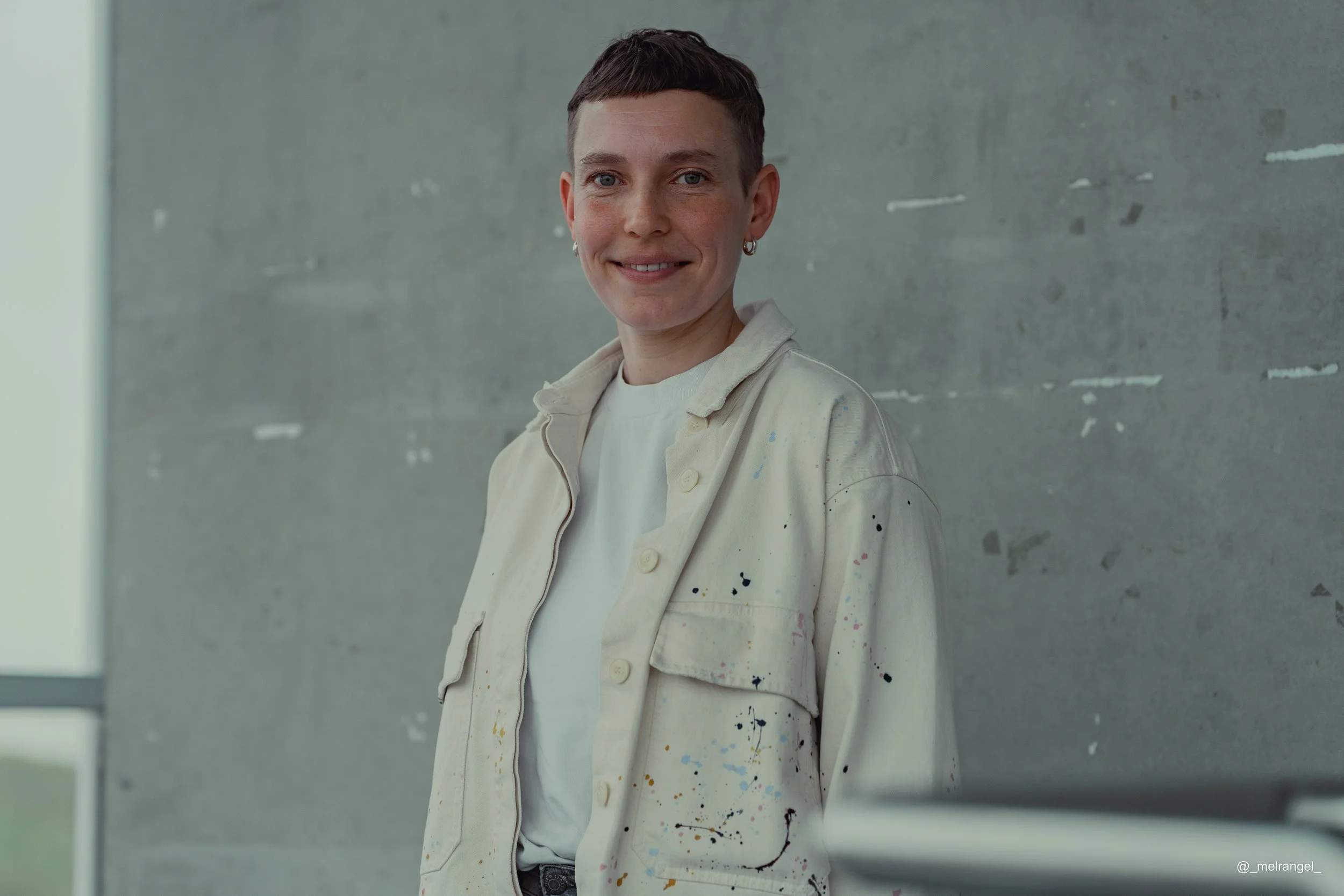
Our thirty-third member of the month is Simone Austen-Heimberg
UCRF is running a ‘Member of the Month’ feature on this blog, where a member, selected at random from the membership database, is sent five questions to give us all an overview of our members. Our thirty-third participant, Simone Austen-Heimberg is a fashion designer, educator, and researcher working at the intersection of sustainability, design pedagogy, and systemic change, with a focus on relational design practice, value networks, and the role of designers as agents of transformation within fashion systems.
1. How would you sum up your research/practice?
My research and practice are concerned with how fashion designers can become agents of systemic change. I work with the concept of curated value-netting (kuratiertes Wertnetzen), which I developed in my master's thesis "Fortune in Fair Fashion". It reframes design as a relational practice — not "What do I design?", but "With whom and how do I design?". This shifts the focus from product to the value-based relationships that produce it. My research builds on practice: ten years in sustainable fashion at Vivienne Westwood, Hessnatur, and Armedangels.
2. How do you address fashion and sustainability in your work?
I treat sustainability not as a constraint or obligation, but as a creative possibility space: one that holds economic, aesthetic, and ethical value simultaneously. In practice, this has shaped my work for over a decade: at Hessnatur, I initiated and co-designed the Zero Waste Capsule Collection, integrated into the regular main collection. At Armedangels, I built up the menswear material range and developed the Circular Knit Project — both as efforts to translate sustainability from communication into supply chain reality. In teaching, I create affinity spaces (Gee) where students from different design disciplines encounter sustainability not as a fixed answer, but as a shared design question. In research, I currently develop the concept of capable design characters — what dispositions and educational formats enable designers to act in complex value networks.
3. What are the conflicts you have encountered around fashion and sustainability in your work?
The most persistent conflict is the gap between narrative sustainability and systemic sustainability. Brands often communicate sustainability as a product attribute (a fibre, a certificate) while leaving the underlying relationships untouched. A second conflict: the marginalisation of fashion design within sustainability discourses. Designers are positioned as either heroic problem-solvers or guilty consumers — rarely as relational actors who shape value flows. A third conflict has become more visible to me through teaching: states of uncertainty within the design process are still widely seen as weakness — something to hide. But for sustainable design, these uncertain phases are not optional; they are essential. As Ronald A. Beghetto puts it: "There is no creativity without uncertainty — Dubito Ergo Creo" (2021). Teaching design today, for me, also means teaching uncertainty as a legitimate, productive mode. This is also a matter I want to take forward in my research.
4. What do you consider the key sources and cases when it comes to fashion and sustainability?
For me, the key references are: Timo Rissanen and Holly McQuillan on Zero Waste Fashion Design (a personal influence since 2010, when I first encountered Rissanen's work at Parsons); Kate Fletcher's writing on craft and slow practice; Kirsi Niinimäki's work on circular fashion systems; and Bryan Lawson on the structure of design processes more generally. Among the cases that have shaped my thinking: Vivienne Westwood's principle of "buy less, choose well, make it last", the Hessnatur Zero Waste Capsule Collection (which I designed), and the Fashion Revolution movement as a model for transforming sustainability into public dialogue.
5. Could you recommend some less-known sources or cases you think should be more widely shared?
I would name three. First: Marisa Fonseca Braga's "Fifth Order of Design" (Cubic Journal, 2023), which positions ethics as a constitutive structure of design — a framing I find more generative than the usual "ethical layer added on top". Second: Ian de Vere's work on ambiguity in design pedagogy — too little known in the German-speaking context, but essential for teaching sustainability beyond binaries. Third: Ronald A. Beghetto's "There is no creativity without uncertainty: Dubito Ergo Creo" (2021)— a brief but radical text that reframes uncertainty not as a deficit, but as a precondition for genuine creative work.
Thank you Simone for sharing your work!
